The huge county of Sussex boasts immense beauty, from its dramatic coastline to the rolling countryside of the South Downs, not to mention its picturesque villages and bustling market towns. It’s no surprise then that a county with such a rich landscape and history has a hefty catalogue of folk tales, myths, and legends to call its own.
Take just a peek, and you’ll discover dragons, wily villagers, strange forests and the uncanny presence of the Devil, who seems to be particularly active in this pretty county! Maybe it's because Sussex held off converting to Christianity last, or its particular resilience as a major access point for invading hordes, but the folklore of this county is particularly dramatic and intense.
Here’s our pick of the top tales that weave their magic into the fabric of Sussex…
A word of warning… By the nature of folklore, some of these strange tales may feature dark content, so continue with caution…
The Devil’s Jumps
The Devil’s Jumps, a collection of Bronze Age burial mounds near Midhurst, are swathed in folklore and strange tales. The most commonly known involves the Devil himself, who on the sabbath would amuse himself by jumping from mound to mound, shouting at the poor parishioners as they made their way to and from church.
Fed up with his behaviour, the plighted people prayed to God, who sent down the Archangel Michael (although interestingly, other versions claim it was the Norse god Thor) to stop him. The magnificent Archangel (or Thor) threw an immense rock onto the Devil, plunging him deep into the earth. Although archaeologists have since identified the humps as barrows, it is said the area still holds on to its strange, still energy. So watch out when visiting the Devil’s Jumps – Old Nick himself may just jump out at you!
The dragon of Knucker Hole
This tale involves a ‘Knucker’, a Sussex word for a water dragon. This Knucker lived in a deep pond near the village of Lyminster and was particularly ferocious, with a huge wingspan and teeth as long (and sharp) as swords. Any poor soul who was unfortunate enough to wander too near the pond was eaten. In despair, the villagers reached out to the king for help, who offered a huge reward for anyone who killed it. Many tried and died, for the Knucker was wily and terrible.
However, a local called Jim Puttock came up with a plan. He made a huge pie and filled it with poison and took it to the Knucker. The Knucker, on seeing Jim, decided to lure him into the pond and eat him. But Jim told him to try the pie first, to whet his appetite. The greedy Knucker ate the pie whole and immediately became unconscious, giving Jim the opportunity to chop off its head with an axe. The villagers celebrated and treated Jim to food and drink, but silly Jim had forgotten to wash the poison off his hands and died.
The Yew Trees of Kingley Vale
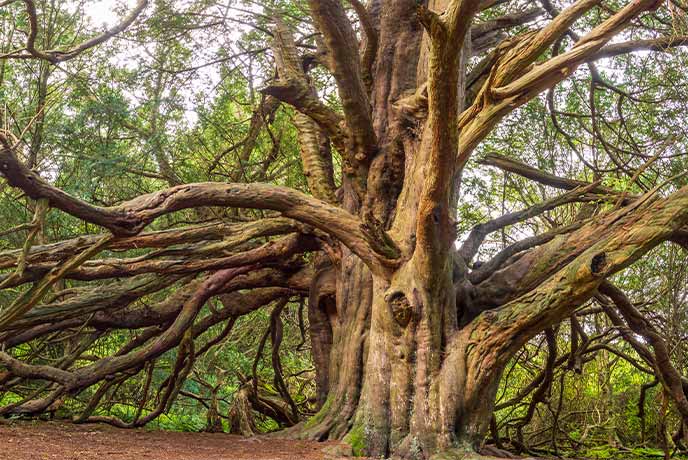
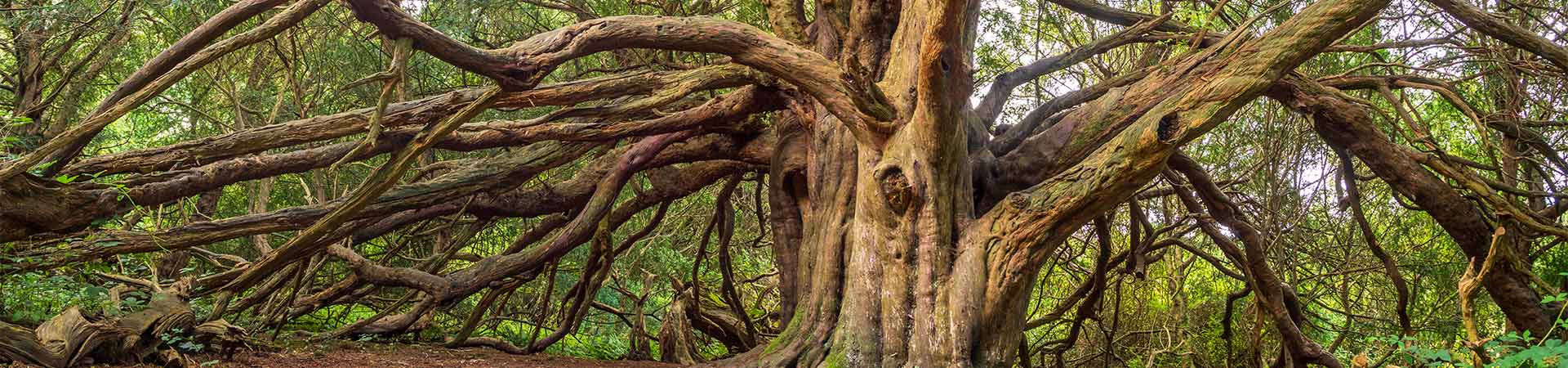
The ancient yew tree forest of Kingley Vale lies in the heart of the South Downs, and its trees are said to be between 500 and 2,000 years old – some of the oldest living things in the whole of Britain. It’s no surprise, then, that it’s a place loaded with legend and strange tales. It is said that a huge battle took place here between the Anglo-Saxons and invading Vikings around AD 859, with the fallen soldiers from both sides buried beneath the trees.
Since then, tales abound of ghostly forlorn figures flitting between the trees, trying to find their way home, and even tales of the soldiers’ souls entering the trees themselves and coming alive at night. Kingley Vale is also said to have been a favourite haunt of druids. It’s not surprising, as even today the place has an otherworldly feel. It’s the perfect spot for a woodland walk, just keep an eye out for spectral Vikings!
The ghosts of Pevensey Castle
The incredible fortress of Pevensey Castle is one of the oldest in the county. Built in the 4th century on the ruins of a Roman fort, it has a rich history to match. It’s no surprise then that it has its fair share of spooky residents who call its ruins home. Situated near Eastbourne, the castle is said to have its very own ‘Grey Lady’ who roams the castle in mournful silence. It’s not known who the unfortunate ghost is, but some believe she’s Joan of Navarre, the second wife of Henry IV, who was imprisoned at Pevensey after being accused of witchcraft and poisoning the king.
Others claim the ghost is Lady Joan Pelham, who wrote to her husband, Sir John Pelham, for help after the castle came under attack, and who wandered the castle and grounds awaiting his return. Other ghosts include a shadowy monk, a man dressed in black, and the sounds of an army in battle.
Chanctonbury Ring
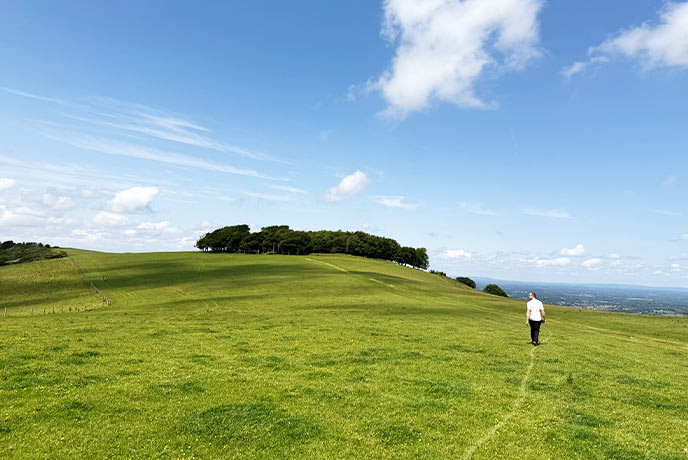
The Iron Age hilltop fort of Chanctonbury Ring is a stunning place to visit, and definitely a must for a walk with spectacular views. Dramatically positioned in the beautiful South Downs near Pulborough, it was planted with a ring of trees in the (relatively) recent 18th century, lending it a mysterious air. Legend has it that if you dare walk around the ring counterclockwise seven times on a moonless night, you’ll summon the Devil, who will then either do your bidding or, curiously, offer you a bowl of porridge or soup.
Another tale talks of Roman soldiers doomed to patrol the fort for eternity in silence, with the glitter of their armour showing up on a moonlit night. Whether you dare to visit on the night of a clear full moon, or in the safety of a summer’s day, you’ll be blessed by glorious panoramic views over the South Downs after climbing to the top. The ancient earthworks, interesting trees, and peaceful atmosphere also make this a great picnic spot.
The Golden Calf of Trundle
Not far from the coastal town of Chichester and within hearing distance of the hooves of the racing horses at Goodwood, lies St. Roche’s Hill. At the top of the hill lies an ancient Iron Age fort, ‘Trundle’. Legend has it that a golden calf is hidden here (possibly the very same one as mentioned as a false idol in the bible by Moses), but when anyone tries to find it, the Devil (yes, him again) moves it somewhere else.
Another version about buried treasure involves the Vikings, the same ones that battled in Kingsley Vale as mentioned above. Legend has it that the raiders stopped here on their way to battle to bury it and keep it safe, leaving a calf by it so they could find it on their return. Of course, the Vikings were defeated, so the treasure was left, as was the calf, and the poor beast’s ghost is still said to roam the hilltop, its spectral bleatings sometimes carrying over the breeze.
The Devil’s last stand at the Devil’s Dyke
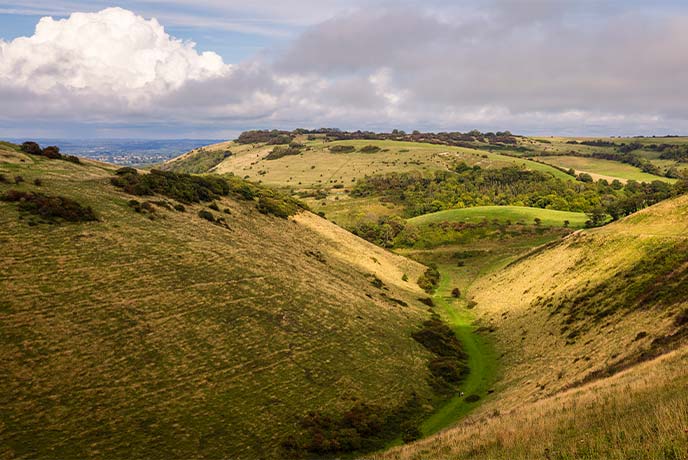
The county of Sussex was one of the last in England to be convinced by Christianity, but by the beginning of the 7th century, people started to convert. Legend has it that the Devil, so infuriated by this, decided he was going to drown everyone by digging a huge trench from the sea into Sussex. St Cuthman, the chap behind the sudden influx of Christianity, was having none of this, so wagered with the Devil that if he managed to complete the task by sunrise, he could have his soul. If not, he would have to leave Sussex.
The Devil, convinced he couldn’t lose, dug ferociously and with great speed. St Cuthman, horrified, realised that the Devil would win, so devised a cunning plan. Visiting a nearby house, he lit a candle. A nearby cockerel, thinking it dawn, crowed. The Devil, seeing the light and hearing the cockerel, cursed St Cuthman and ran off, smashing the coastline as he went, creating the Isle of Wight and leaving behind the Devil’s Dyke.
The Midsummer Tree of Worthing
In a small, nondescript part of the seaside town of Worthing by a roundabout, you may discover an ancient oak tree, some 300 years old, with its own plaque. This is the Midsummer Tree, a hallowed spot for local folklore. It is said that at midnight on Midsummer’s Eve, skeletons rise up from its roots and, holding hands, perform the dance of the dead around the tree until dawn and the cockerel crows, when they sink back down into the earth.
Although there are numerous records of ‘witnesses’ to this phenomenon, as many of them (one suspects) were on their way home from the pub, it’s perhaps best to err on the side of caution with this tall tale!
Feeling inspired by our folk tales? Take a look at our stunning holiday cottages in Sussex and start planning your getaway today.