The county of Hampshire, with its perfect blend of coast and countryside and two National Parks, may conjure up images of a county of blissful tranquillity, but when it comes to folk tales, myths, and legends, things are definitely not all sweetness and light! Here, you’ll find aquatic beasts in unusual places, an ancient holy tree that’s literally living history, kings snoozing underground, and man-eating terrors in this fascinating collection of folk tales. So pour yourself a hot cup of something, make yourself comfortable, and let us lead you into the world of the strange and uncanny.
A word of warning… By the nature of folklore, some of these strange tales may feature dark content, so continue with caution...
The Bisterne Dragon
This New Forest legend makes its way all over the verdant countryside and tells the tale of a naughty dragon who made himself a nuisance. Every day he would leave his den at Burley Beacon in search of milk which he would get from Bisterne. The locals, fed up with having to give all their milk to the fiery creature, asked a local knight – named Berkeley – to kill it. The brave man, along with his two dogs, laid in wait at the usual spot the dragon came for his milk, and jumped out and attacked the beast as he took his first slurp. The immense battle, said to have raged all over the New Forest, climaxed just outside Lyndhurst, when the knight defeated the dragon, whose body turned into a hill, now known as Bolton's Bench. Sadly, the knight, so broken by the battle, died 30 days and 30 nights later, on top of the same hill. It is said that his yew bow fell to the ground and sprouted into a yew tree, which can still be seen today.
The strange case of the Highclere Grampus

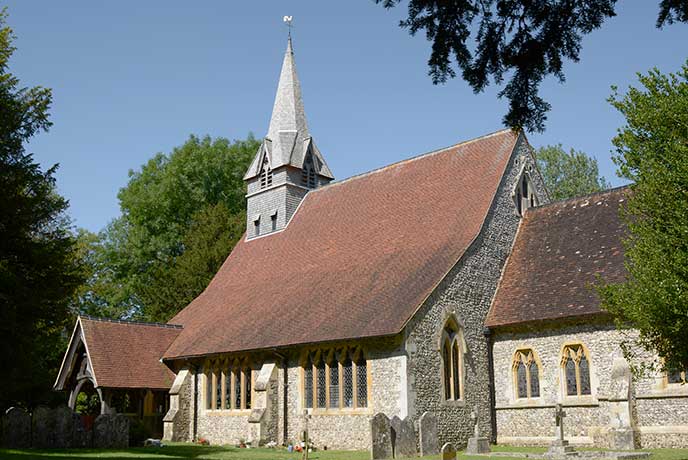
This odd little tale takes place in the chapel of Highclere Estate near Newbury, which may be a familiar name for ‘Downton Abbey’ fans as the castle is the film location for the impressive Downton Abbey itself. This fishy folklore however is probably as far removed from the Dowager Countess as you could get! The tale tells of a Grampus, an ancient word for a big fish, that lived in a yew tree in the chapel’s churchyard (yes, you read that right). How a sea-dwelling creature managed to travel a good deal inland and survive, and live in a tree no less, is not explained. All we know is that the bizarre creature terrified locals walking past by grunting and wheezing, and chasing them if they got too close. The beast was eventually got rid of by a local clergyman who exorcised it from the tree and churchyard. How it got there in the first place, or where it went afterwards, nobody knows, but this has to be one of England’s most nonsensical tales!
The Gospel Oak of Avington
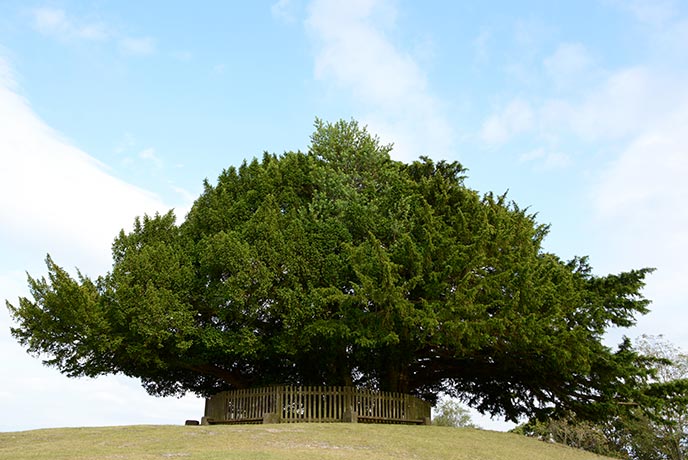
This true tale takes us back to when England was blanketed in great woodlands and forests, much-loved by William the Conqueror who had a passion for hunting. King William’s relative, Walkelin, was appointed the Bishop of Winchester and requested that a cathedral be built, using wood from Hampage Wood. Despite William’s love of the woods and hunting, he agreed to the request, saying he could have as much wood as he could get in four days and four nights. Calling on men in the area, Bishop Walkelin cut all the forest down bar one oak tree. Known as a ‘Gospel Oak’, it was said that St Augustine himself preached from under its branches when he brought Christianity to Britain in the 6th century. Although William was furious with the Bishop for the decimation of his trees, the cathedral was built and the oak remained, with a new wood growing around it. Protected by iron railings in the 19th century, the ancient hollow oak tree still remains today.
The mermaid of Nately Scures

If you happen to pay a visit to the small but perfectly formed Norman church at Nately Scures, a sleepy hamlet near the village of Hook, you’ll spot an unusual carving of a striking mermaid, beadily looking you in the eye. With tendrils of hair mingling with the sea in the background and a strong, determined look on her face, this beautiful mermaid also has a small figure on its back. Over the years, the mermaid has invoked many conversations as to her origins, with one particular folk tale taking hold. It was said that a local lad, gone to sea as a sailor, had a love affair with a mermaid. However, suffering from homesickness, he abandoned her and came home, where he fell in love with a girl from Nately Scures. The mermaid, determined not to lose her love, travelled across the sea, up the River Thames and other tributaries untilr she reached the River Lyde by the church, and stole the would-be groom away, who was never seen again.
The King beneath the hill
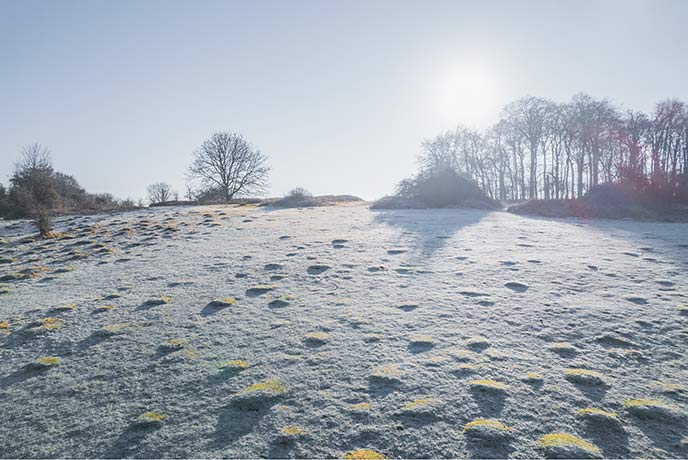
While exploring the myths and legends of all the counties in England, it feels like each has its own tale involving King Arthur, and Hampshire is no exception. Outside of the city of Winchester lies St Catherine’s Hill, said to look like a sleeping dragon if you look at it a certain way. It’s believed that underneath this peculiar hill lies a sleeping King Arthur, surrounded by his knights and a huge horde of treasure. He sleeps, deeply, awaiting a day when England is in dire need of help, and someone is brave enough to find the bell within the barrow and ring it, to awaken him and his knights. Of course, the idea of hidden treasure has drawn many a would-be hunter to try and find it, but tales tell of grisly ends for anyone who attempted it. The links to King Arthur are strengthened by the 13th century round table which can be found in the Great Hall at Winchester Castle.
The Cockatrice of Wherwell
Hampshire definitely has more than its fair share of beastly folklore, and none more so than this one. Taking place in the village of Wherwell on the River Test, not far from Stockbridge, the story tells of a duck who laid an egg in a crypt of all places. This crypt was in Wherwell Abbey, and instead of being hatched by the duck who abandoned it, a broody toad took on the responsibility. When the egg finally hatched, the creature that emerged was a hodgepodge of various animals; the body of a cockerel, wings of a bat and the tail of a snake. Initially adopted by the kind villagers who fed it, it grew and grew and began to eat the villagers themselves, flying over the countryside with its bat wings, picking people off as it travelled. Eventually, a man called Mr Green took on the task of killing it, using a sheet of metal as a mirror to trick the cockatrice into fighting itself, before plunging a spear into its side. It’s said that part of Harewood Forest, called Greens Acres, is named after him.
The strange inhabitants of the New Forest

With its wild, ancient woodland said to have little-changed since the days of Henry VIII, who would ride amongst the trees while hunting, it’s really not a surprise that there’s a rich source of folktales surrounding the New Forest. Take Yernegate for example. A massive giant who lives deep in the forest, he is said to be a guardian of the land who gets angry when men take too much wood. One particular tale tells of him throwing a greedy woodsman so far he landed on the moon. Other stories speak of Colt Pixies, a type of pixie that takes on the form of the ponies that roam through the land and who like to lead travellers and animals astray – often to their deaths. Ghosts also live here too – the famous Blue Lady ghost of Palace House in Beaulieu was so believed that even the writer Sir Arthur Conan Doyle (of Sherlock Holmes fame) held a séance in order to connect with her. Let’s not forget the trees either – from hanging trees to groaning elms, there’s tales a-plenty for the forest’s arboreal inhabitants.
St Swithun
Now this name might ring a bell to many, but here’s the story behind the myth. St Swithun was a bishop of Winchester, who was well-loved by everyone for all the good things he did for the town and its people. On his death in the 9th century, he was buried outside the cathedral as he had requested. However, on the 15th July 871 the decision was made to move the body, and at that very moment, it began to rain and continued to rain for forty days and nights. As a result the saying goes:
St Swithun’s day, if thou be fair,
For forty days it will remain.
St Swithun’s day, if thou bring rain,
For forty days it will remain.
And it’s still believed by many that should it rain on St Swithun’s Day (the 15th July), we’re in for a rainy month or so!
Feeling inspired to explore these mythical lands? Take a look at our beautiful holiday cottages in Hampshire and start planning your getaway today.