From giant worms and devilish witches to King Arthur and modern-day beasts, there’s no doubt that Somerset is home to more than its fair share of fascinating myths and legends.
From its craggy hilltops to the wave-kissed coastline, Somerset’s folklore rivals its landscapes for jaw-dropping sites and sights. Traverse the untouched hills of the Quantocks, explore ancient castles and esoteric towns or head out into the wilderness of the moors, and you’ll find a gripping tale to add a bit of sparkle to any place you visit.
While there’s a host of myths to discover, here’s a selection of our top legends and the places they are set, to get your imagination truly going!
A word of warning… By the nature of folklore, some of these tales can feature dark content, so proceed with caution.
Beast of Exmoor
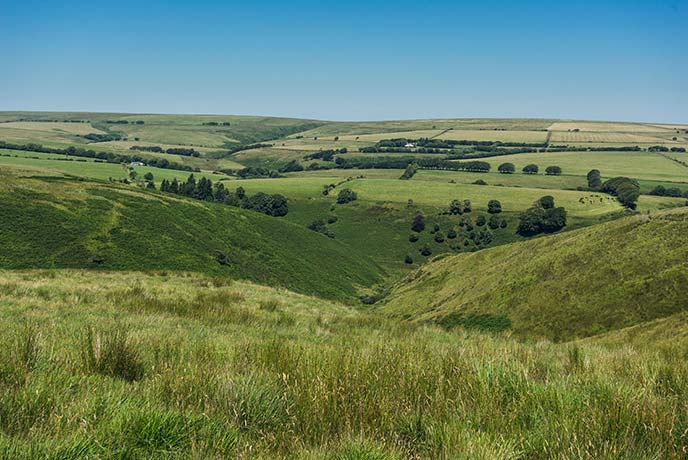
This fascinating modern-day legend rears its head every now and again, but was originally first reported back in the 1970s. Believed to be a large, black, cat-like animal, this cryptid is said to roam the moors of Exmoor and is more often than not spotted by hikers out walking or farmers who spy it along the hedgerows.
Looking much like a panther or a puma and around six feet in length, it became headline news in the early 1980s when a farmer lost over 100 sheep, attributing the loss to a large cat. Although there have been numerous sightings over the years, definite proof remains elusive, with people pondering the wild beasts’ origins. Some believe it to be an escaped or released exotic pet after keeping large cats became illegal in the UK in the 1970s, while naysayers think sightings are simply mistaken and are actually just large domestic cats, deer or dogs.
Whatever the truth of the matter, the Beast certainly is alive and kicking in local, living legend and is a wonderful addition to the cryptozoology (the study of hidden or unknown animals) and fascinating folklore of the British countryside. So when you’re out and about exploring the delights of Exmoor National Park, make sure to keep an eye out, just in case…
King Arthur and Glastonbury Abbey
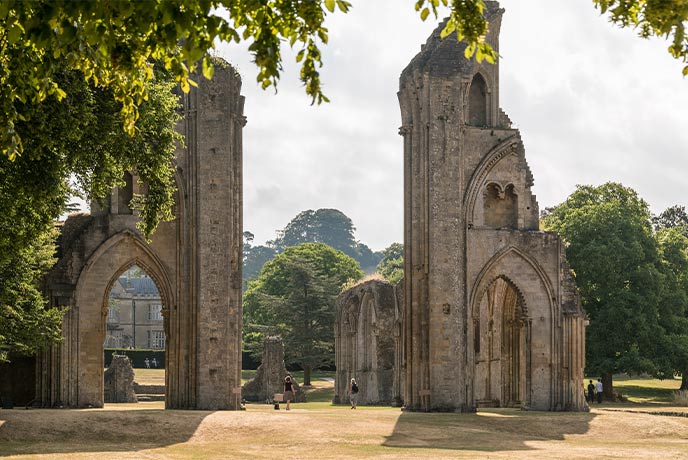
One of Britain’s greatest tales, that of King Arthur, is intrinsically linked with Somerset, and no more so than at Glastonbury Abbey, which is said to be his final resting place and that of his queen, Guinevere. The tomb is believed to have been discovered in 1191 and finally reburied with much aplomb sometime between 1274 and 1291 by King Edward I and Queen Eleanor, with a striking black marble tomb, which survived until the dissolution of the abbey in 1539.
Today, you can find the tomb within the abbey ruins with a simple marker showing the original burial site. As you stand there, it’s easy to imagine days of yesteryear, with Arthur and his queen and courtiers visiting this holy site, maybe frequenting the nearby Chalice Well in their search for the Holy Grail, travelling on horseback through the surrounding misty Vale of Avalon, and maybe climbing the Tor for panoramic views of the countryside he ruled.
The Dunster Dragon
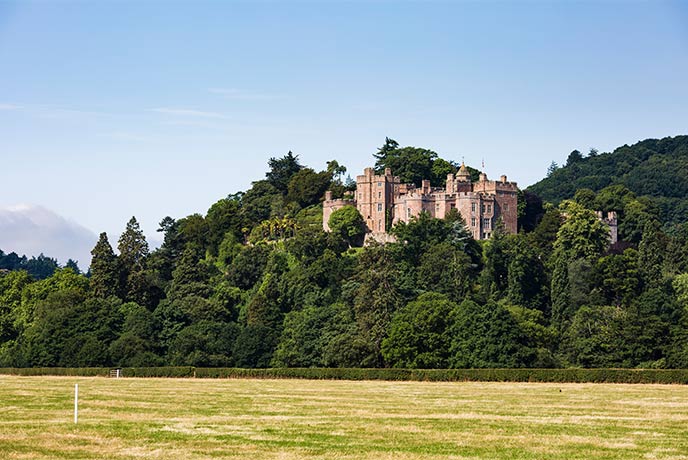
Who knew that the charming medieval village of Dunster, with its gorgeous castle, was once home to a ferocious dragon? According to local legend, the fearsome creature was said to dwell in the hills surrounding the village, terrorising the poor people who lived there. The people of Dunster did all they could to scare the dragon off, but it wouldn’t go away, choosing to make its lair in the grove of ancient yew trees (which still stand today), said to have magical powers all of their own.
Eventually, a brave knight was found and came in to save the day, confronting the dragon in battle and eventually killing it. This is one of those tales that lurks around the edges; not much is known about it, and it definitely has a familiar ring to it (hello, Saint George). But as you wander around the beautiful village, with over 200 listed properties, it’s not hard to be drawn back to ancient times and maybe catch a glimpse of scaly skin slinking through the trees and the scent of smoke in the air.
Bride’s Mound
Much mystery and wonder surround this little-known spot. Sometimes called ‘Brides Mound’, the site is a small hill near Glastonbury, close to Beckery, Wearyall Hill, and the River Brue. One of the county’s lesser-known spiritual places, it is considered by some to be the western entrance to what was Avalon. With its own particular and unique energy, archaeologists have in the past discovered the remains of early Christian structures, such as a chapel, while there are also remains of a burial ground dating back to the 5th century, making it one of the earliest known monastic sites in the UK.
The name ‘Bride’ is linked to St. Brigid (both a Celtic goddess and a saint), who was said to have visited this site and honoured here, while Arthurian legend has it that the site was a monastery for ‘holy virgins’, which King Arthur visited and had a vision of the Virgin Mary and the baby Jesus. Other tales tell of this being the gateway to the fairy realm, and that on the night of a full moon, the fairies come out to dance on its summit. If you pay this fascinating spot a visit, you’ll find it a peaceful, calming pilgrimage, and definitely off the beaten track compared to Glastonbury’s more well-known sites.
Glastonbury Tor
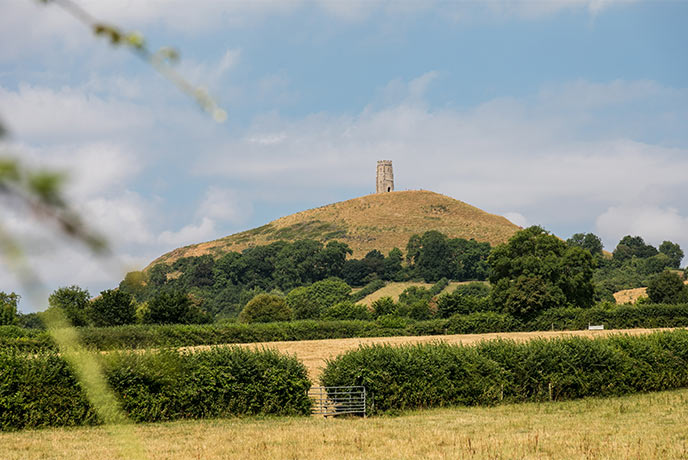
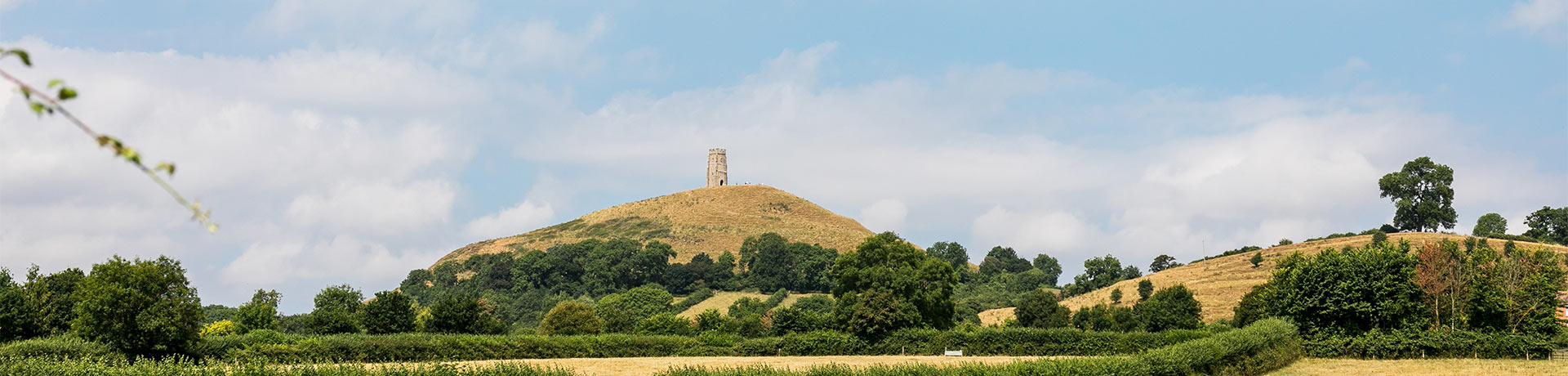
Majestic and imposing, the Glastonbury Tor can be seen for miles around, rising out of the Somerset Levels, so it’s no surprise there’s a host of stories surrounding it. Centuries ago, the Levels was a vast marshy and tidal area, so the tor would have appeared like an island, gaining the name the ‘Isle of Avalon’.
It also gained a reputation for being many mystical things of importance, such as the home of the faerie folk, a portal to another realm, the gateway into the land of the dead (known as Avalon or Annwn in Celtic), and the home of the Lord of the Underworld.
There are also tales of Joseph of Arimathea bringing a young Jesus here, while others claim the Holy Grail is buried underneath it. At the base of the Tor lie two healing springs that are uniquely different – a red one (due to the iron content – known as the Chalice Well and linked to the Grail) and a white one (due to the calcite content). Aerial views show a labyrinthine structure winding its way around the hill, which has inspired many ponderings on its purpose. Whatever the truth is behind the Tor, spending time here at sunrise or sunset will leave you in no doubt of its magic.
The Giant Worm of Shervage Wood
This is the tale of a giant worm, known as the Gurt Wyrm, who terrorised any people and animals who dared enter Shervage Wood, nestled in the Quantock Hills. Said to be the length of three large oak trees, it would slither hither and thither, picking off livestock and anyone who might dare to creep under the trees to collect berries.
It was said that an old, wily woman who lived by the wood’s edge was fed up with the nuisance worm and decided to do something about it. While out one day, she happened to meet a big, strapping woodcutter who was travelling through the area. After welcoming him into her home and giving him a meal and cider, she pointed him in the direction of the woods to walk through as a good shortcut. The woodcutter, not knowing about the worm, happily set back off on his journey.
The way was hard, though, so midway he stopped to rest on a large log, which to his surprise began to wriggle under him. Laughing, he told it to stop, but it wouldn’t, so he angrily cleaved the log in two with his axe, causing blood to spill on the ground. Realising it was a giant worm, he stepped back in shock while one half of the worm wriggled off to nearby Bilbrook and the other to Kingston, whereupon the creature died.
The Witch of Wookey Hole
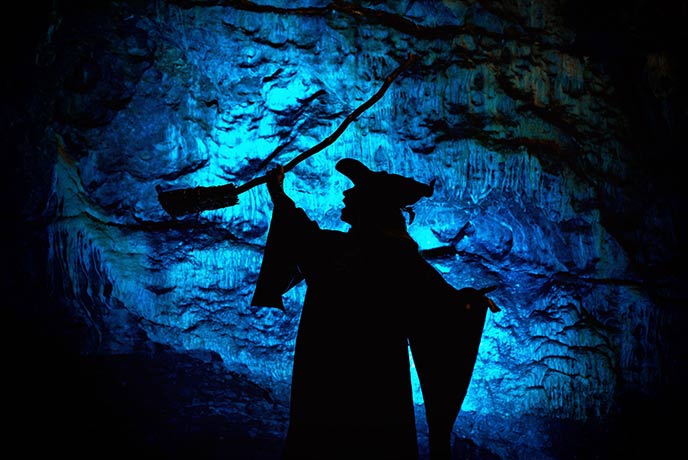
Probably one of Somerset’s most famous legends, the Witch of Wookey Hole has been a part of Somerset folklore for centuries. This tale begins almost 1,000 years ago in Wookey Hole, a series of magnificent caves that lie near Wells, when a woman who lived in the caves was treated with suspicion and fear by the local villagers.
Whenever misfortune took place, be it crops failing, people disappearing, or cattle dying, all blame was placed at her feet, and in due course they approached Glastonbury Abbey for help. The Abbot sent a determined monk, who, well-equipped with holy items, made his way into the caves to find her. At the entrance, she confronted him, angry for being victimised, but he persisted and chased her deeper into the caves, despite the villagers' warning that the caves were the entrance to hell.
Using his holy chalice to make holy water taken from the River Exe, the monk sprinkled it, whereupon a blood-curdling scream resonated throughout the cave, and the witch was turned to stone. Today, visitors can see the petrified form of the witch in Chamber One, where you can clearly see her nose, forehead, chin and even her bonnet. What at first appears as a fun tale for visitors to enjoy, in 1912 archaeologists actually discovered the remains of a woman, accompanied by the remains of two goats, a bowl, a dagger, a latch lifter and an alabaster ball (which can be found today in Wells Museum) – so maybe this folk tale is more factual than we first thought!
The Glastonbury Thorn
The Glastonbury Thorn was a sacred tree set on the slope of Wearyall Hill overlooking the town of Glastonbury. Arguably, the tree with the most history, myth and legend of any other in the world, it was believed to be the descendant of the tree that grew from the staff of Joseph of Arimathea. Following the crucifixion of Christ, legend has it that Joseph travelled to Britain to bring Christianity to the people, and while here, he thrust his staff into the ground, and overnight it grew into a blossoming thorn tree, from which the current one is descended.
The tree, apart from its unique heritage, was also unusual as it was the only hawthorn of its kind to blossom both in winter (usually around Christmas) and spring. As a result, the reigning British monarch received a flowering sprig every Christmas. Sadly, the original tree was destroyed during the English Civil War by supporters of Oliver Cromwell, and while a part of the tree was saved and propagated, that too has now been removed. The spot where the tree stood still promises incredible views, though, so it's still worth the climb when exploring Glastonbury.
Want to discover Somerset’s living legends for yourself? Take a look at our beautiful holiday cottages in Somerset and book your folktale-inspired getaway today.